

Explore GTA 6 Intel
News, Guides & Updates
In-depth technical analysis, RAGE 9 engine breakdowns, and verified Vice City gameplay guides.









Cyber Leek: The Definitive Nexus for Next-Gen Open-World Intelligence
An investigative, research-driven publication dedicated to dissecting game engine software architecture, world cartography, physical simulations, and verified developments shaping modern interactive entertainment.
1. The Renaissance of Interactive Sandboxes: Why GTA 6 Redefines the Paradigm
For over four decades, interactive entertainment has evolved through distinct technological epochs. We have transitioned from the rudimentary pixel grids of early home consoles to the textured polygonal corridors of the late nineties, and eventually into the sprawling urban sandboxes pioneered in the early 2000s. Yet, despite monumental visual advancements across past console cycles, open-world video games frequently remained constrained by fundamental hardware bottlenecks. Slow mechanical hard disk drives (5400 RPM HDDs) dictated artificial speed limits to prevent texture popping; limited system memory restricted non-playable character diversity; and static lighting baked into pre-calculated lightmaps rendered virtual environments visually rigid.
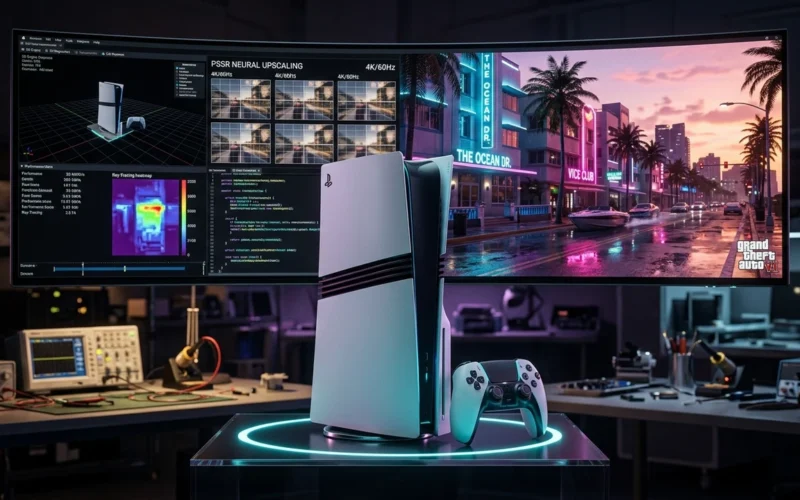
Grand Theft Auto VI marks the dawn of a genuine paradigm shift. Built specifically to exploit dedicated high-speed NVMe solid-state storage, multi-threaded processor architectures, and hardware-accelerated ray tracing cores, this title departs from traditional illusion-based game design. At Cyber Leek, we observe this transformation not merely as the continuation of a beloved entertainment franchise, but as a historic software engineering milestone. We examine how individual simulation pillars—hydrodynamics, volumetric meteorology, behavioral artificial intelligence, and procedural kinetic animations—interlock seamlessly to construct a living, breathing digital universe that responds dynamically to player intervention.
2. The State of Leonida: Architectural Authenticity and Cultural Satire
The geographic foundation of Grand Theft Auto VI is the fictional state of Leonida—an expansive, culturally nuanced, and ecologically varied territory inspired by Florida and the broader American Southeast. Rather than confining gameplay solely to municipal borders, Leonida represents an ambitious continental ecosystem where gleaming metropolitan wealth exists alongside raw, untamed wilderness.
The crown jewel of this territory is modern Vice City. Returning to this legendary sun-soaked setting after more than two decades is far more than a simple exercise in retro nostalgia. While the classic 2002 title paid homage to the pastel synthwave swagger of the 1980s, modern Vice City is an uncompromising, razor-sharp reflection of the contemporary 2020s. Influenced by the explosive growth of modern Miami, the city captures the intoxicating juxtaposition of luxury mega-condominiums, vibrant Art Deco coastal promenades, bustling container ports, and high-energy social media street culture.
Ocean Beach & Promenade
Pastel Art Deco hotel strips, wide pedestrian esplanades, beach volleyball courts, and radiant neon reflections bouncing across wet asphalt during twilight rain showers.
Downtown Financial Core
Towering glass-and-steel commercial skyscrapers, elevated multi-tier freeway overpasses, corporate banking headquarters, and accessible subterranean parking complexes.
The Grassrivers Ecosystem
A treacherous wetland wilderness of sawgrass marshes, shallow airboat canals, dense mangrove roots, and living indigenous fauna including alligators and wading herons.
The Keys & Overseas Highways
Monumental concrete bridges spanning azure tropical waters, connecting remote fishing outposts, secluded luxury marinas, and barrier coral reef diving coves.
3. Engineering the Virtual Frontier: Inside the RAGE 9 Architecture
Beneath the visual splendor of Grand Theft Auto VI beats the technological heart of the Rockstar Advanced Game Engine (RAGE) in its ninth major generational iteration. Developed by internal technology groups across decades, RAGE 9 represents one of the most sophisticated proprietary software platforms in computer science. Unlike general-purpose third-party engines designed to accommodate diverse genres, RAGE 9 is custom-tailored specifically for massive, multi-tiered systemic open-world simulations.
Three core architectural pillars distinguish RAGE 9 from all preceding frameworks:
- Real-Time Hydrodynamics and Water Simulation: In sub-tropical coastal environments, water is not a decorative flat surface with animated textures; it is modeled as an active physical fluid medium with density, viscosity, and buoyancy. Ocean waves propagate organically based on wind velocity, coastal bathymetry, and hull displacement. High-speed watercraft displace physical water, generating authentic wake lines that rock nearby docks and ripple outward toward sandy coastlines.
- Hardware-Accelerated Ray Tracing & Global Illumination: RAGE 9 transitions entirely to physically based rendering (PBR) augmented by hardware ray tracing. Sunlight bouncing off coastal sand illuminates building soffits with warm diffuse indirect light, while vibrant commercial neon signs cast real-time colored illumination onto rain-slicked roads, vehicle paintwork, and moving pedestrians without relying on distorted screen-space approximations.
- Volumetric Meteorology and Atmospheric Moisture: The sky is no longer a static panoramic image; clouds exist as dynamic three-dimensional volumetric bodies governed by simulated atmospheric pressure and temperature gradients. Sub-tropical humidity scatters optical light waves realistically, producing authentic twilight god rays, localized rain squalls, and authentic atmospheric haze that grounds every scene in reality.
4. Living Human Ecosystems: The Behavioral Artificial Intelligence Revolution
One of the most persistent shortcomings in open-world titles has been the mechanical behavior of non-playable characters (NPCs). Traditionally, pedestrians follow predetermined looped paths and react to disturbances with generic panic animations. In Grand Theft Auto VI, patented software systems assigned to Rockstar’s technical leadership introduce revolutionary leaps in contextual cognitive modeling.
Citizens across Leonida maintain individual daily routines, spatial memory, and situational decision trees. Pedestrians do not merely walk aimlessly; they commute to workplaces, visit local boutiques, exercise along coastal boardwalks, and socialize at outdoor cafes. When unexpected weather strikes, crowds react organically—seeking shelter beneath store awnings or deploying umbrellas. Furthermore, reflecting contemporary digital culture, bystanders routinely capture chaotic street events on smartphones, stream viral occurrences to in-game social media networks, and interact with the protagonists based on historical street notoriety, attire, and demeanor.
5. Narrative Architecture: Jason & Lucia and the Currency of Mutual Trust
While expansive maps and graphical fidelity provide the canvas, emotional resonance is the soul of storytelling. In Grand Theft Auto VI, Rockstar Games pivots from the disparate three-protagonist model of GTA V to an intimate, highly focused dual-character narrative centered upon Jason & Lucia.
Drawing thematic inspiration from the classic American romantic outlaw archetype, their partnership is grounded in the harsh realities of contemporary economic struggle and survival. Lucia brings fierce tactical determination, street-smart pragmatism, and unyielding resilience following her journey through the correctional system. Jason serves as the observant, tactically disciplined anchor with mechanical and logistical expertise. Together, their dynamic introduces cooperative mechanics that redefine gameplay: synchronized tactical breaches, seamless real-time character switching without loading delays, shared financial progression, and grounded inventory management where heavy equipment is stored physically inside vehicle trunks rather than an invisible bottomless pocket.
6. Vehicular Dynamics: The Marriage of Simulation Weight and Precision Handling
Automobiles represent the primary conduit through which players experience the world of Grand Theft Auto. For GTA 6, vehicular physics have undergone a comprehensive ground-up redesign, harmonizing the grounded physical weight and suspension travel of GTA IV with the responsive, thrilling precision of GTA V.
Tires continuously sample surface friction coefficients across varied substrates—from dry baking asphalt to rain-dampened tarmac, loose beach sand, and swamp mud. Suspension systems dynamically calculate chassis roll, pitch, and yaw under aggressive throttle application and threshold braking. Furthermore, real-time procedural damage deformation replaces pre-modeled dent swaps: body panels crumple mathematically based on impact velocity and angle, while mechanical damage directly alters handling geometry, radiator temperatures, and tire inflation pressure.
7. Editorial Integrity and Compliance: The Cyber Leek Standard
At Cyber Leek, our fundamental editorial creed is built upon transparency, factual verification, and ethical journalism. In a digital environment too often crowded with sensationalist clickbait, fabricated forum rumors, and unauthorized data breaches, we maintain an unwavering commitment to responsible reporting.
Our analytical articles are derived exclusively from verified public sources: official developer trailers, corporate investor earnings transcripts, registered patent documentation, and scholarly engineering evaluations. We operate in strict compliance with Google AdSense program policies, intellectual property laws, and digital media ethics. We reject unverified piracy, confidential file leaks, or copyright infringement, focusing entirely on providing our global readership with lawful, educational, and authoritative gaming analysis that enriches the player community.
8. Frequently Asked Questions (FAQ) About GTA 6 & Cyber Leek
Q: What is the primary mission of Cyber Leek?
Cyber Leek is an independent gaming journalism publication dedicated to delivering in-depth technical analysis, verified news tracking, gameplay guides, and world design breakdowns for Grand Theft Auto VI and next-generation open-world gaming.
Q: Which platforms are confirmed for Grand Theft Auto VI?
Rockstar Games has officially confirmed that Grand Theft Auto VI is scheduled to launch initially on current-generation consoles: PlayStation 5 and Xbox Series X|S, taking full advantage of fixed high-performance hardware architectures.
Q: How does the map size of Leonida compare to previous open worlds?
Based on community cartographic triangulation and revealed landmarks, the state of Leonida is substantially larger in physical landmass than GTA V's Los Santos and Blaine County combined, with an unprecedented leap in enterable interior spaces, verticality, and ecological biomes.
Q: Is Cyber Leek affiliated with Rockstar Games or Take-Two Interactive?
No. Cyber Leek is an independent editorial news portal. All trademarks, registered logos, and intellectual property associated with Grand Theft Auto belong solely to Rockstar Games, Inc. and Take-Two Interactive Software, Inc. Our analysis operates strictly under fair use principles for journalistic reporting and educational commentary.